Germany needs nurses, and many hospitals and care homes recruit abroad. But nursing is a regulated profession in Germany: you may only work as a registered nurse (Pflegefachfrau, Pflegefachmann or Pflegefachperson) once a German authority has recognised your qualification and given you a licence to practise. This guide walks you through the whole route, from your first document to your first shift.
This guide is general information, not legal advice. Rules differ between the 16 federal states and change from time to time. Always confirm the details with the authority that handles your application and with the official sources linked at the end.
The route at a glance
- Check whether your qualification is from the EU or from outside the EU.
- Apply for recognition (Anerkennung) in the federal state where you want to work.
- Learn German to B2 and prove it with a recognised certificate.
- If the authority finds differences, close the gap with a knowledge test or an adaptation course.
- Choose the right visa or residence permit.
- Get your licence to practise and start work as a registered nurse.
Step 1: EU or non-EU qualification?
What counts is where you trained, not your passport. Nurses with a qualification from an EU or EEA country or Switzerland generally get automatic recognition. If you trained anywhere else, for example in India, the Philippines, Kenya, Nigeria or Brazil, you go through an individual recognition procedure. The rest of this guide is about that route.
Step 2: Apply for recognition
You apply to the competent authority in the federal state where you plan to work. You do not need to live in Germany to apply, and a recognition granted by one state is valid in all of Germany. Many employers and recruitment agencies help with the application.
You have two options:
- Equivalence assessment: the authority compares your training with German nursing training. It usually takes about three to four months once your file is complete. The result is full, partial or no equivalence.
- Waiver: you skip the comparison and go straight to an adaptation programme. This shortens the procedure and lowers the fees, but your work experience and further training are then not taken into account, so the programme may be longer.
Typical documents include your nursing diploma and transcript with hours and subjects, proof of registration in your home country, a CV, proof of identity, and later a medical certificate of fitness to work as a nurse and a certificate of good conduct. Authorities usually ask for certified copies and certified German translations. Each state publishes its own checklist, so use the one from your authority.
Step 3: German at B2
For the licence to practise you need German at level B2 of the Common European Framework (CEFR). Many authorities accept a general B2 certificate, and some prefer or require a nursing-specific exam such as telc Deutsch B1·B2 Pflege. Ask your authority which certificates it accepts before you book an exam.
German usually takes longer than the paperwork, so start early. A realistic plan is A1 and A2 in your home country, B1 before or soon after you arrive, and B2 with nursing vocabulary for the ward. Our guide Which German level do nurses need? explains what each level means in daily work.
Step 4: The deficit notice, then a knowledge test or an adaptation course
Most nurses trained outside the EU receive a notice that lists the differences between their training and German training (often called a Defizitbescheid). That is normal and not a rejection. You then close the gap in one of two ways:
- Knowledge test (Kenntnisprüfung): an exam with an oral and a practical part, based on the German nursing exam. It is usually faster if you already have solid experience and good German.
- Adaptation course (Anpassungslehrgang): supervised work and training in a German hospital or care home, often for several months, followed by a final interview. You learn the German way of working and often earn money while you do it, for example as a nursing assistant.
The notice usually says which options you have and may name providers. Tell the authority which one you choose. When you pass, you receive a certificate and the authority checks the remaining requirements for the licence.
Step 5: The right visa
If you are not an EU citizen, you need a residence permit. The most common routes for nurses are:
- Recognition residence permit (Section 16d): for nurses with partial recognition who complete the knowledge test or adaptation course in Germany. It is usually granted for up to 24 months and can be extended by 12. German at about A2 is the general minimum, though courses often require more. Work related to your field is allowed with approval from the Federal Employment Agency.
- Recognition partnership: you come to Germany with a German job contract and start or finish recognition after arrival, together with your employer. It needs a foreign nursing qualification of at least two years of training and German at A2.
- Skilled worker visa (Section 18a): for nurses whose recognition is already complete and who have a concrete job offer.
Note: the EU Blue Card does not apply to nurses. The Opportunity Card (Chancenkarte) lets you come to look for work under certain conditions, but you still need recognition to work as a registered nurse. Employers can ask the local foreigners' office for the fast-track procedure to speed up your visa.
Step 6: Licence and first job
With full recognition, B2 German, the medical certificate and the certificate of good conduct, you receive your licence to practise and may use the protected title. Many nurses already work for their future employer during the adaptation course, so the move to a full contract is often smooth.
When you compare job offers, check the pay scale, shift pattern, help with housing, the language course offer and who pays the recognition and visa fees. Be careful with contracts that make you repay large sums if you leave early, and never pay an agency just to be placed in a job.
How long does it take?
It depends most on your German. Starting from zero, plan on one to two years from your first German lesson to your licence; with German already at B1 it can be much faster. The recognition decision itself usually takes a few months once the file is complete; the knowledge test or adaptation course and the visa add more time.
Free official help
- Make it in Germany, the federal government's portal: make-it-in-germany.com (search for "nursing").
- Recognition in Germany, with the "Recognition Finder" for your authority: anerkennung-in-deutschland.de.
- Service Center for Professional Recognition (ZSBA): free advice for people abroad, including on the waiver.
- ProRecognition: free counselling in several countries outside Germany.
Prepare your German with Kognixr
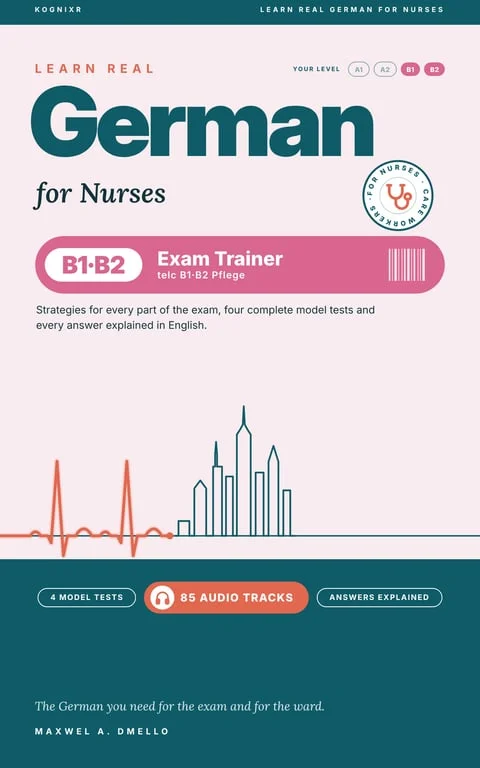
Kognixr's German for Nurses A1–B1 online course takes you from your first words to B1 with real ward situations: handovers, patient care, documentation and talking to relatives. For the exam, the online course for telc Deutsch B1·B2 Pflege trains every part of the test with audio. Both are also in the Kognixr All-Access subscription, and the first 2 lessons of every course are free.
The telc course is independent preparation and is not published or endorsed by telc gGmbH.
Frequently asked questions
Can I work as a nurse in Germany with a foreign nursing degree?
Yes, once a German authority has recognised your qualification and given you a licence to practise. Nurses trained outside the EU usually go through an individual recognition procedure and need German at B2.
How long does it take to become a nurse in Germany?
It depends mostly on your German. Starting from zero, plan on one to two years from your first German lesson to your licence. The recognition decision itself usually takes a few months once your file is complete.
Can I use the EU Blue Card as a nurse?
No. The EU Blue Card does not apply to nurses. Nurses usually come with a recognition residence permit, a recognition partnership or a skilled worker visa.