This guide is general information, not legal advice. Rules differ between the federal states and change from time to time. Always confirm the details with the competent authority and the official sources named below.
New to the topic? Start with How to work as a nurse in Germany: the full route.
Most nurses trained outside the EU receive a notice from the recognition authority that lists the differences between their training and German nursing training. People often call it a Defizitbescheid. It is not a rejection. It tells you exactly what you still need to do before you get your licence.
What the notice says
- Which areas differ from German training (for example certain practical placements or hours in elderly care or paediatrics)
- Which compensation measure you can choose: a knowledge test, an adaptation course, or both options
- Sometimes the names of providers for courses and exams
You must tell the authority which measure you choose. When you pass, you receive a certificate, and the authority checks the remaining requirements for your licence: German at B2, the medical certificate and the certificate of good conduct.
The knowledge test (Kenntnisprüfung)
The knowledge test is based on the German state nursing exam. It has an oral part and a practical part, where you care for patients under observation and explain what you do. Many providers run preparation courses of a few weeks or months.
Good for you if: you have solid recent experience, your German is already good, and you want to finish quickly.
The adaptation course (Anpassungslehrgang)
The adaptation course is supervised work and training in a German hospital or care home, often for several months, with theory lessons and a final interview. You learn the German way of working, the documentation and the team routines.
Good for you if: you want to settle in gradually, you prefer learning on the job to a big exam, or your notice lists many differences.
Working while you finish
During an adaptation course you often already work and earn money, for example as a nursing assistant, under supervision. Rules differ between states and professions, so ask the authority and your employer before you start.
If you do the measure in Germany and you are not an EU citizen, the usual residence permit is the recognition permit (Section 16d). It is usually granted for up to 24 months and can be extended by 12. German at about A2 is the general minimum, but many courses ask for more.
How to choose
- Read the notice with your employer or an advice service. The list of differences decides a lot.
- Compare the time each option takes in your region, including waiting lists for exam dates.
- Be honest about your German: the knowledge test is oral and practical, in German.
- Ask who pays. Many employers pay for the course or the exam preparation.
Prepare your German with Kognixr
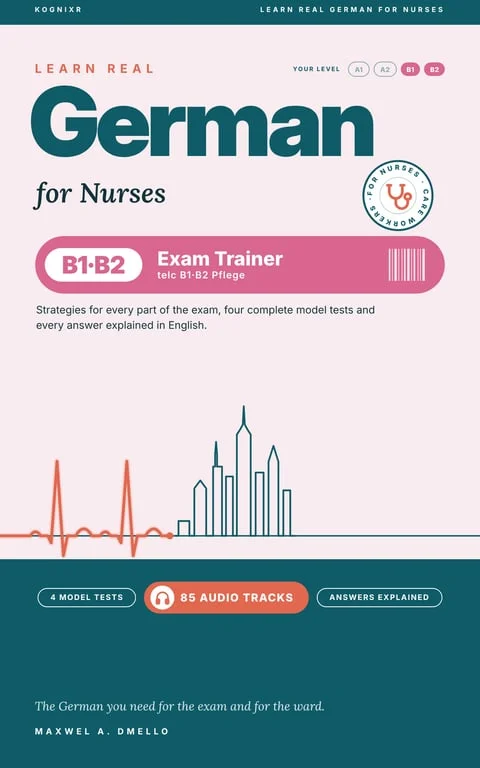
The German for Nurses A1–B1 online course teaches the German you need on the ward, from handovers to talking with relatives. The online course for telc Deutsch B1·B2 Pflege trains every part of the exam with audio. Both are included in Kognixr All-Access, and the first 2 lessons of every course are free.
The telc course is independent preparation and is not published or endorsed by telc gGmbH.
Frequently asked questions
Is a deficit notice a rejection?
No. It lists the differences between your training and German nursing training and tells you how to close them, with a knowledge test or an adaptation course.
Which is faster, the knowledge test or the adaptation course?
The knowledge test is often faster if you have solid experience and good German. The adaptation course takes longer but lets you learn on the job and often earn money while you do it.
Can I work during the adaptation course?
Often yes, for example as a nursing assistant under supervision. Rules differ between states, so ask your authority and employer.