
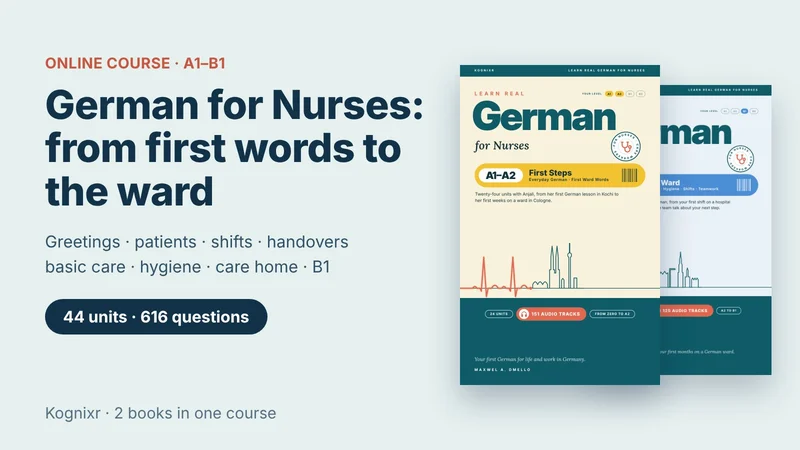
The online German course for internationally trained nurses and care workers: from the first greetings to confident ward German at B1, with ward scenes, key phrases, grammar and 616 auto-marked questions. Instructions and explanations are in English. Text-based: audio is not included; every listening text is in the transcripts.
Enrol now · €69.00 Try 2 lessons free
Pay once, lifetime access · Study on phone or computer · Every answer explained
What's inside
- 12 modules, 128 lessons, 44 quizzes with 616 questions, all marked automatically and explained
- A1–A2 · First Steps (24 units): greetings, your job, numbers, the ward, du and Sie, arriving in Germany, shifts, appointments, pain and medicines, morning care, reporting and handovers
- B1 · On the Ward (20 units): the first working day, vital signs, the handover, basic care, mobilisation, hygiene, blood sugar, prophylaxis, the care home, dementia, relatives, admissions and feedback
- Every unit: a ward scene with English translation, key phrases, words, grammar, tasks, transcripts and a full answer key
- Grammar references, word lists, ward abbreviations, a B1 check and both ebooks (EPUB)
Try 5 questions from the course
Click an answer to see straight away whether it is right, with the explanation.
What does sich Sorgen machen (um) mean?
Answer: to worry (about). sich Sorgen machen (um) = to worry (about).
What does sich setzen mean?
Answer: to sit down. sich setzen = to sit down.
How do you say this in German? I check blood pressure and pulse.
Answer: Ich kontrolliere den Blutdruck und den Puls.. I check blood pressure and pulse. = Ich kontrolliere den Blutdruck und den Puls.
What does heute · morgen mean?
Answer: today · tomorrow. heute · morgen = today · tomorrow.
What does die Pflegehelferin / der Pflegehelfer mean?
Answer: nursing assistant. die Pflegehelferin / der Pflegehelfer = nursing assistant (plural: -nen / -).
How it works
After you pay, you log in at the Kognixr shop (shop.kognixr.com) and start straight away. Your progress is saved. To come back later, use “My downloads & courses” in the footer.
Who it is for
Nurses and care workers trained outside Germany who are starting German or have A2, and want to work on a German ward or in a care home. The next step after this course is the telc Deutsch B1·B2 Pflege exam course. Prefer the books? Learn Real German for Nurses A1–A2 · First Steps, or the Learn Real German for Nurses series.
Independent self-study course by Kognixr. It does not lead to an official certificate.
Questions and answers
Do I need any German to start?
No. Unit 1 starts with greetings, and every instruction and explanation is in English.
Is there audio?
No. The course is text-based: each ward scene has an English translation and every listening text is in the transcripts. Read the dialogues aloud to practise.
Does it prepare me for the telc Pflege exam?
It takes you to B1 on the ward. For the B1·B2 exam itself, continue with the Kognixr telc Deutsch B1·B2 Pflege exam course.
Do I get a certificate?
You get a Kognixr certificate of completion. It is not an official language certificate and does not replace a recognised exam.
How long do I have access?
For life. You pay once, there is no subscription, and you can repeat every lesson and quiz as often as you like.
Can I study on my phone?
Yes. The course runs in your browser on phone, tablet or computer, and your progress is saved.
Can I try it first?
Yes. The first 2 lessons are free, and you can try 5 sample questions on this page.