If you are a nurse trained outside Germany, German is usually the longest part of the road. Your nursing degree may be excellent, but on a German ward you hand over patients, document care, talk to relatives and answer the phone in German. That is why the language level is part of the recognition process.
This guide explains what the levels mean in practice and what is usually asked for. Rules differ between the federal states (Bundesländer) and change from time to time, so always confirm the current requirement with the authority that handles your application.
The short answer
- B2 is the level most authorities ask for before they grant full recognition as a nurse (Pflegefachfrau / Pflegefachmann).
- B1 is often enough to come to Germany and start working in an assisting role while your recognition is still in progress, for example during an adaptation period or while preparing for the knowledge test.
- A1 and A2 are the foundation. You will not work as a nurse at this level, but you need them to reach B1 and B2.
What each level means on the ward
| Level | What you can usually do |
|---|---|
| A1 | Introduce yourself, ask simple questions, understand slow, clear everyday German. |
| A2 | Talk about routine topics, follow simple instructions, fill in basic forms. |
| B1 | Talk with patients about everyday care, understand most handovers if colleagues speak clearly, write short notes. |
| B2 | Give and follow detailed handovers, explain care to patients and relatives, document care accurately, handle phone calls and unexpected situations. |
Which exams prove your level
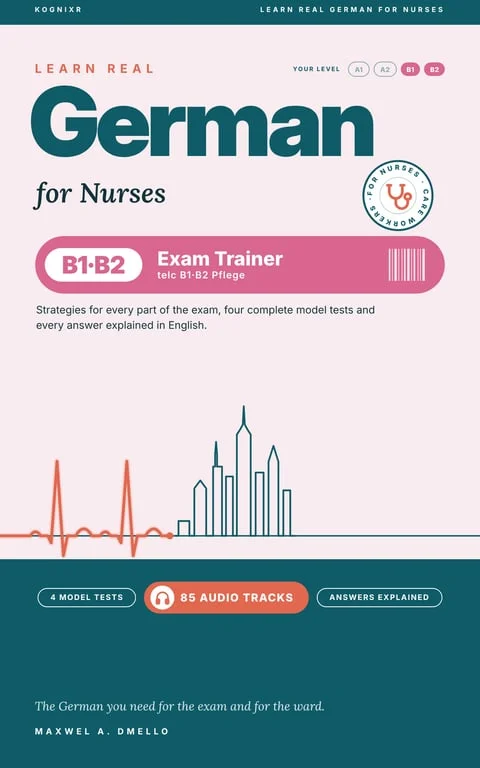
Authorities usually accept certificates from recognised providers. Besides general German exams, there are exams made for care work, for example telc Deutsch B1·B2 Pflege. Its tasks are set in hospitals and care homes, so the vocabulary you study is the vocabulary you will use at work. Ask your authority which certificates it accepts before you book an exam.
Some states also hold a separate medical-language check for nurses. Again, the authority dealing with your file can tell you whether this applies to you.
How to plan your learning
- Build the base (A1 to A2). Learn everyday German first: numbers, times, appointments, simple conversations. A structured course keeps you moving.
- Add care vocabulary early. From A2 on, learn the words for body parts, symptoms, care tasks and hospital routines. You will remember them better when you meet them in real situations.
- Practise the exam format. When you approach B1, work with model tests so the exam tasks hold no surprises.
- Speak every day. Handovers and conversations with patients are spoken skills. Read dialogues aloud and record yourself.
Books that help
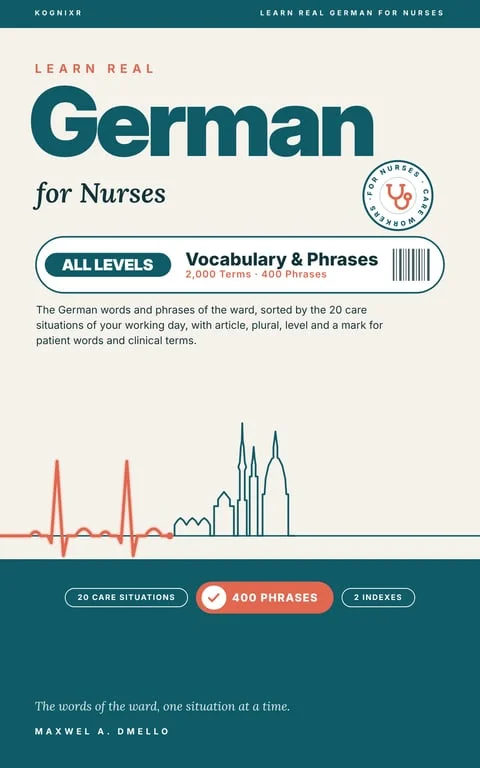
Start with Learn Real German A1 and Learn Real German A2 for the foundation. Add Learn Real German for Nurses – Vocabulary & Phrases for the words and phrases of everyday care, sorted by situation. When you are ready for the exam, the Exam Trainer for telc Deutsch B1·B2 Pflege walks you through every part with model tests. The exam trainer is an independent preparation book and is not published by or affiliated with telc.
Not sure where you are now? Read about German levels A1 to B2 and start at the level that fits.