German has a reputation for being hard, but the first two levels are very reachable for English speakers. English and German share thousands of words (Haus, Hand, Wasser, beginnen), the alphabet is the same and the pronunciation is far more regular than in English. What slows most beginners down is not talent but a plan that is too vague. This guide gives you a realistic one.
What A1 and A2 actually mean
At A1 you can introduce yourself, ask and answer simple questions, handle numbers, times and prices, and get through short everyday exchanges if the other person speaks slowly. At A2 you can talk about your routine, your work and your past, make appointments, deal with shops, doctors and landlords, and write short messages and emails. A2 is the level many employers, landlords and integration courses expect as a first step. See German levels A1 to B2 explained for the full picture.
How long it takes
Most adult English speakers need roughly 150–200 hours of study to reach a solid A1 and another 150–200 hours for A2. With 45 minutes a day, five days a week, that is about six months from zero to A2. With less time, plan for nine to twelve months. Consistency matters much more than long weekend sessions.
What to learn first
- Sounds and spelling (week 1): ä, ö, ü, ß, the ch sounds and the fact that w sounds like English v. Ten minutes a day of reading aloud saves months later.
- Survival phrases (weeks 1–2): greetings, Wie bitte?, Können Sie das wiederholen?, numbers, times and prices.
- Present tense and word order (weeks 2–6): regular verbs, sein and haben, the verb in second position, questions with W-Wörter.
- Nouns with their article (always): learn der Tisch, die Lampe, das Buch, never just Tisch. It is the single best habit for German.
- Modal and separable verbs (A1 end): können, müssen, wollen, aufstehen, anfangen. They unlock real everyday sentences.
- The past and longer sentences (A2): the Perfekt (ich habe gearbeitet, ich bin gefahren), weil and dass clauses, the dative after common prepositions.
A weekly routine that works
- 3 days: one new unit: read the dialogue, read it aloud twice, study the grammar box, do the exercises.
- 1 day: review: redo yesterday's exercises without looking, test yourself on the new words with the article.
- 1 day: use it: write five sentences about your own life with the new language, or say them out loud.
- Every 6 units: a review test. If you score under about 70 %, go back before you move on.
Mistakes that slow beginners down
- Learning words without the article. You will have to relearn them all later.
- Translating word order from English. In German the verb comes second: Heute arbeite ich, not Heute ich arbeite.
- Never speaking. Read every dialogue aloud. Your mouth needs practice as much as your head.
- Skipping reviews. New units feel like progress; reviews are where the language actually sticks.
- Waiting to be "ready" to use German. Order a coffee, write a two-line message, ask a neighbour a question. A1 is meant to be used.
Books and course
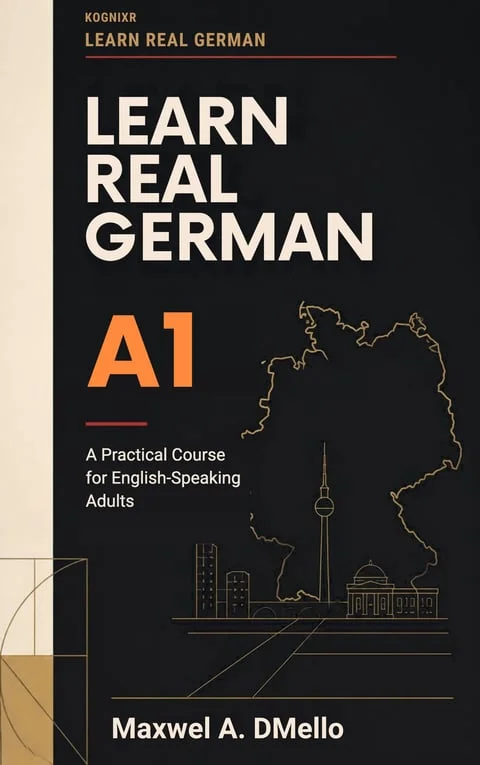
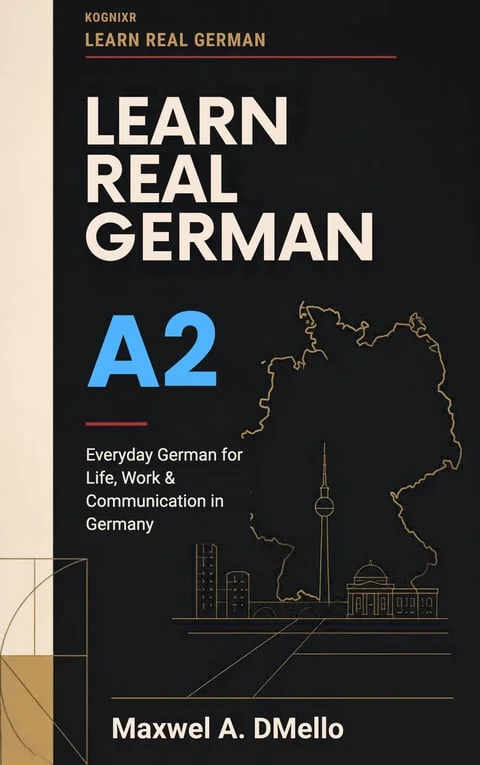
Learn Real German A1 and Learn Real German A2 are written for English speakers: every unit has a real-life dialogue, grammar explained in English, core vocabulary and practice with a full answer key. If you prefer to study online with marked quizzes, the German A1–A2 online course combines both books into 50 units with 897 auto-marked questions.